Synology PAS7700 Future-Proof Active-Active NVMe Storage
- 2 Million 4K Random IOPS
- All-NVMe Active-Active Chassis
- Sub-Millisecond Latency
- Up to 100GbE Native Core
Evolving Multi-Tenant and Storage Bottlenecks
Costly Disruptions
Unplanned business downtime during OS firmware upgrades or structural controller failovers halting transactional operations.
I/O Performance Drops
Massively parallel task pools such as virtualization arrays, AI modeling workloads, or backend EDA simulations causing system blockages.
Ransomware Vulnerability
Sophisticated payload vectors intentionally altering live primary enterprise datasets, leaving backups compromised.
Storage Footprint Inflation
Inefficient internal dataset distribution scaling raw compute budgets unnecessarily due to missing hardware data compression layouts.
Complex Infrastructure Management
Struggling with detached storage landscapes split across block (SAN) and file-level configurations (NAS).
Scalability Dead-Ends
Reaching early limits on system drive slots, forcing companies into costly full hardware trade-ins rather than simple unit additions.
Continuous Availability.
Outstanding Efficiency.
Active
Hardware Resilience
Dual 2U server controllers with 24-core AMD EPYC CPUs ensure uninterrupted access with instant passive failover.
Unified Block & File Protocol Engine
Natively process massive block and file arrays over NVMe-oF, iSCSI, SMB, and high-speed NFS over RDMA.
Inline Data Deduplication & Automated Tiering
Maximize array usage with inline compression and automated cold data tiering.
Immutable Protection & Compliance Safeguards
Stop unauthorized encryption with WORM, immutable snapshots, and SED support for compliance.
Accelerate Your Primary Production Workloads
AI & ML Analytics
Direct-to-GPU structures and high NVMe-oF data transfers ensure large machine learning models avoid storage data starvation.
Virtualization Storage
CSI-ready Kubernetes storage systems and reliable IOPS profiles enable fast boot times for up to 1,000 corporate VDI users.
Post-Production Media
30 GB/s speeds support real-time editing workflows across multi-user 8K video asset timelines without frame dropping.
EDA & Engineering
Natively process millions of concurrent file streams during advanced semiconductor layouts and automated regression tests.
Massive Scale-To-Fit Storage Architecture
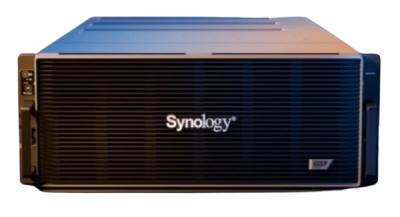
- 48 All-Flash U.2/U.3 NVMe drive slots within a 4U rackmount
- Expands up to 216 drives via seven PAX224 high-density expansion shelves
- Supports up to 1.65 PB of raw solid-state flash array storage
- Validated compatibility with high-density TLC NAND flash media configurations
- NTB hardware synchronization for fast write-cache protection mirroring
Frequently Asked Questions
What are the core technical specifications and performance benchmarks of Synology PAS7700?
How does the active-active design of the PAS7700 provide continuous business uptime?
What protocols are natively supported on Synology PAS7700?
What software ecosystem runs the Synology PAS7700 enterprise flash system?
Transform Your Production Storage Infrastructure

705 Madhuban Building,
55 Nehru Place,
New Delhi-110 019