
As organizations accelerate digital transformation and adopt Artificial Intelligence (AI), cloud computing, and connected business applications, cybersecurity has become more critical than ever. While these technologies create new opportunities for innovation and business growth, they also expand the attack surface, exposing organizations to increasingly sophisticated cyber threats.
The challenge is not just deploying advanced security technologies but ensuring that these technologies are continuously monitored, managed, and supported by skilled cybersecurity professionals.
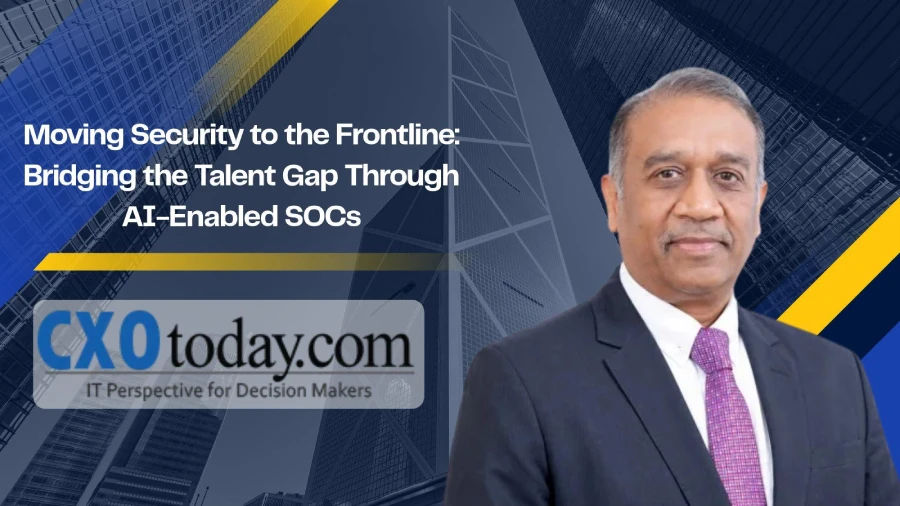
In a recent interview with CXOToday, Mr. Subir Sangal, CEO of Eagle, shared his perspective on the evolving cybersecurity landscape, the growing shortage of specialized IT and cybersecurity talent, and the importance of AI-enabled Security Operations Centers (SOCs) in helping businesses strengthen their cyber resilience.
The Expanding Cybersecurity Landscape
The enterprise technology landscape has evolved significantly over the past decade. Organizations that once relied primarily on traditional IT infrastructure now operate across cloud platforms, remote endpoints, digital applications, APIs, and third-party environments.
With the growing adoption of Generative AI, the complexity has increased further. Sensitive business information may move across multiple applications and platforms, creating new security challenges involving data protection, identity management, access controls, and application security.
Cybercriminals are also leveraging AI to develop more convincing phishing campaigns, automate reconnaissance, and execute sophisticated social engineering attacks.
As Mr. Sangal highlighted in the interview, businesses must ensure that security evolves alongside technology adoption rather than becoming an afterthought.
This requires organizations to establish continuous visibility across their IT environments through 24×7 SOC Monitoring, Managed Detection & Response (MDR), Cloud Security Monitoring, Threat Intelligence, and other integrated security capabilities.
Why Deploying Security Tools Is Not Enough
One of the key insights from the interview was the importance of continuous monitoring.
Organizations invest in multiple cybersecurity solutions, including firewalls, endpoint detection systems, identity management platforms, and network security tools. However, deploying these solutions alone does not guarantee protection.
Mr. Sangal explained this with a simple example: installing security cameras at home provides visibility, but their effectiveness depends on someone continuously watching them.
Enterprise cybersecurity works in much the same way.
Security tools generate thousands of events and alerts every day. Without continuous monitoring, investigation, and timely response, critical threats can remain undetected.
An AI-enabled Security Operations Center (SOC) addresses this challenge by combining advanced analytics, automation, and cybersecurity expertise to identify suspicious activities, prioritize threats, and support faster incident response.
By integrating Security Information and Event Management (SIEM), Security Orchestration, Automation and Response (SOAR), and expert security analysts, organizations can improve threat detection and reduce the burden of manual monitoring.
Bridging the Cybersecurity Talent Gap Through AI-Enabled SOCs
The shortage of skilled cybersecurity professionals is one of the biggest challenges facing organizations today.
According to the World Economic Forum’s 2025 cybersecurity workforce estimates cited in the interview, the global cybersecurity workforce faces a shortfall of approximately 2.8–4.8 million professionals.
As businesses adopt AI, cloud technologies, and increasingly complex digital infrastructure, they need professionals with expertise across cybersecurity, networking, cloud security, automation, data, and compliance.
Recruiting and retaining professionals with this combination of skills can be difficult, particularly for organizations that need round-the-clock security coverage.
AI-enabled SOCs offer a practical approach to addressing this challenge.
By using AI and automation to analyze large volumes of security events, identify unusual behavior, and automate predefined response actions, SOC teams can reduce repetitive manual tasks and focus their expertise on investigating and responding to critical threats.
However, AI does not eliminate the need for organizationshuman expertise. Experienced security professionals remain essential for validating alerts, understanding attack patterns, conducting threat investigations, and making critical response decisions.
The combination of AI-driven capabilities and skilled cybersecurity professionals enables organizations to build a more efficient and responsive security operations model.
Strengthening Cyber Resilience with 24×7 SOC Monitoring and MDR
As digital environments become more interconnected, organizations need a proactive and continuous approach to cybersecurity.
A modern SOC provides centralized visibility across endpoints, networks, applications, cloud infrastructure, and user identities. It helps security teams identify suspicious activities and investigate potential threats before they escalate into major incidents.
Managed Detection & Response (MDR) further strengthens this approach by providing specialized threat detection, investigation, and response capabilities.
Other important components include:
- 24×7 SOC Monitoring: Continuous monitoring of IT environments to identify suspicious activities and potential security incidents.
- Managed Detection & Response (MDR): Proactive identification, investigation, and response to cyber threats.
- Proactive Threat Hunting: Searching for hidden threats and suspicious activities that may bypass conventional security controls.
- Security Orchestration, Automation & Response (SOAR): Automating predefined security workflows to reduce manual effort and improve response efficiency.
- Cloud Security Monitoring: Monitoring cloud environments for misconfigurations, suspicious activities, and potential security risks.
- Digital Forensics & Investigation: Analyzing security incidents to understand their origin, impact, and scope.
Together, these capabilities help organizations move beyond reactive security practices towards a proactive and continuously monitored cybersecurity posture.
Securing AI Adoption Through Data Protection and Governance
Another important concern discussed in the interview was the security of AI applications themselves.
As employees increasingly use Generative AI tools, organizations face the risk of confidential business information being shared with unauthorized platforms. Excessive access permissions, insecure APIs, and inadequate data governance can further increase these risks.
For example, an employee may unintentionally upload sensitive customer information into an external AI application.
Data Loss Prevention (DLP) solutions can help organizations detect, alert, and prevent unauthorized sharing of sensitive information.
Alongside DLP, businesses should strengthen identity and access security, application security monitoring, vulnerability management, and data privacy compliance.
Security must be integrated into AI adoption from the beginning rather than introduced after applications have already been deployed.
The Role of Specialized Technology Partners
Building a complete cybersecurity team internally requires significant investment in recruitment, training, technology, and round-the-clock operational resources.
For many organizations, particularly growing businesses, maintaining all these capabilities in-house may not be practical.
As Mr. Sangal explained, combining internal teams with specialized technology partners provides a more flexible approach. Organizations can retain strategic control over their IT environments while leveraging external expertise for specialized cybersecurity operations.
At Eagle this approach is supported through capabilities such as 24×7 SOC Monitoring, Managed Detection & Response, Cloud Security Monitoring, Proactive Threat Hunting, Digital Forensics & Investigation, and SOAR.
This enables businesses to access specialized cybersecurity expertise, continuously monitor their IT environments, and strengthen their security posture without having to build every capability internally.
Making Cybersecurity a Business Priority
As organizations prepare to scale AI and digital transformation initiatives, cybersecurity must become an integral part of their business strategy.
Technology readiness, security governance, data protection, and workforce capabilities must evolve together. Continuous monitoring, effective incident response, employee awareness, and strong access controls are essential to building long-term cyber resilience.
The future of cybersecurity will not depend on technology alone. It will be shaped by how effectively organizations combine AI, automation, skilled professionals, and specialized security partners.
At Eagle, we believe that effective cybersecurity starts with continuous visibility, intelligent monitoring, and expert-led response. Through our comprehensive cybersecurity services, we help organizations stay ahead of evolving threats and focus on their business with greater confidence.
Read the Full Interview.
Explore the complete conversation with Mr. Subir Sangal, CEO of Eagle Information Systems, published by CXOToday, to learn more about the future of AI-enabled SOCs, cybersecurity talent challenges, and building stronger enterprise cyber resilience.
Read the full interview: Moving Security to the Frontline: Bridging the Talent Gap Through AI-Enabled SOCs—CXOToday