
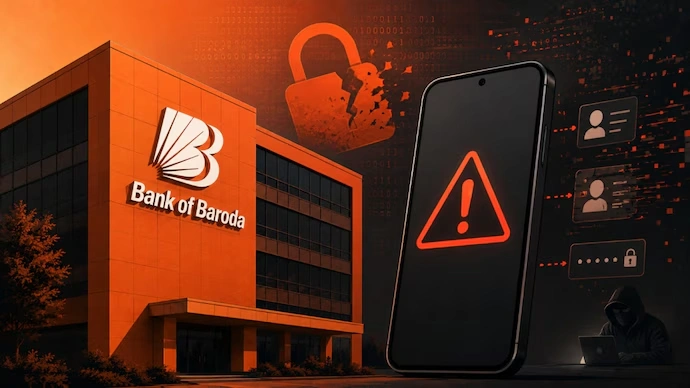
The reported Bank of Baroda data leak has brought renewed attention to a critical cybersecurity challenge: protecting sensitive customer and business data in an increasingly connected environment. Reports in July 2026 indicated that a large volume of Bank of Baroda customer and internal data had surfaced online. The bank said the incident involved the compromise of an employee email account and stated that its core banking systems had not been accessed and remained secure.
For customers, this distinction is important. A data breach does not automatically mean that bank accounts have been compromised or that money can be withdrawn. However, exposed personal information can create opportunities for phishing, identity theft, social engineering and account takeover attempts.
As Subir Sangal, Chief Executive at Eagle Information Systems, noted in his comments to India Today Tech, if leaked information can be used for identity verification or account recovery, there is a potential risk of unauthorised access. He recommended changing passwords, enabling multi-factor authentication where available and closely monitoring account activity.
What Happened in the Bank of Baroda Data Leak?
Reports indicated that hundreds of gigabytes of Bank of Baroda-related information, potentially including customer details, identification documents, loan-related records and internal documents, appeared online.
Bank of Baroda attributed the incident to unauthorised access following the compromise of an employee email account and stated that its core banking systems were not accessed. The complete scope of affected data and customers continues to be assessed.
The incident highlights why cybersecurity cannot focus only on core applications. Email accounts, file-sharing platforms, endpoints, identities and employee access can all become potential entry points for cyber attackers.
5 Things Bank of Baroda Account Holders Should Know
1. A data leak does not necessarily mean your bank account has been hacked
The reported incident does not indicate that Bank of Baroda’s core banking systems were accessed. Therefore, customers should not assume that their bank balance or transactions are automatically at risk.
However, exposed personal information can still be valuable to cybercriminals. Details such as names, identification information, account-related data and other personal records could potentially be used to make fraudulent communications appear legitimate.
This is why identity and access management, multi-factor authentication and continuous security monitoring are important components of a modern cybersecurity strategy, helping organisations strengthen protection against unauthorised access and evolving cyber threats.
2. The biggest immediate risk may be phishing and social engineering
When attackers obtain legitimate-looking customer information, they can use it to create highly convincing phishing scams and social engineering attacks. Familiar details can make fraudulent messages appear genuine and increase the likelihood of customers responding to them.
Customers may receive messages claiming that their account has been blocked, their KYC needs to be updated, or immediate action is required following the data breach. Such messages may be designed to trick users into sharing passwords, OTPs, banking credentials or other sensitive information.
Customers should therefore avoid clicking links in unexpected SMS messages, emails or WhatsApp communications. Instead, they should access banking services only through the official app or website and verify any suspicious requests directly with the bank.
3. Change passwords and strengthen authentication
As a precaution, customers should review their banking credentials and change passwords where appropriate. Passwords should be unique and should not be reused across banking, email and other online accounts.
Where available, multi-factor authentication (MFA) adds another layer of protection by requiring an additional verification factor beyond a password.
From an enterprise cybersecurity perspective, this principle extends across the organisation. Strong identity controls, least-privilege access and continuous authentication can significantly reduce the impact of compromised credentials.
4. Monitor transactions, alerts and credit activity
Vigilance is particularly important following a data breach, as exposed information may be used in attempts to target customers through fraud or social engineering. Staying alert can help identify suspicious activity before it escalates.
Customers should regularly review their bank statements and transaction alerts and report anything unusual immediately. They should also be cautious about unexpected OTP requests, unfamiliar calls from people claiming to represent the bank, or requests for additional personal information.
Since exposed identity information can potentially be misused beyond banking, monitoring credit activity can provide an additional layer of protection. Identifying unfamiliar accounts, transactions or credit enquiries early can help customers take timely action.
5. Businesses need to look beyond the perimeter
The Bank of Baroda incident also offers an important lesson for organisations: cybersecurity is not simply about protecting a firewall or a data centre.
A compromised employee account can potentially provide a pathway to sensitive information. This makes email security, endpoint protection, identity management, employee awareness, vulnerability management, data protection and security monitoring essential parts of an organisation’s overall security posture.
For enterprises handling customer, financial, healthcare or other sensitive information, proactive cybersecurity measures can help identify weaknesses before attackers exploit them.
What Businesses Can Learn From the Bank of Baroda Data Breach
The incident reinforces several cybersecurity priorities for modern enterprises:
Identity & Access Management: Restrict access to sensitive systems and information based on business need, while strengthening authentication controls.
Threat Detection & Monitoring: Continuous monitoring can help security teams identify suspicious behaviour and respond to threats before they escalate.
Vulnerability Assessment & Penetration Testing: Regular VAPT can uncover exploitable weaknesses across infrastructure and applications before attackers find them.
Data Protection: Sensitive information should be protected through appropriate access controls, encryption and security policies.
Incident Response & Recovery: Organisations need clearly defined processes to contain incidents, investigate their impact and restore normal operations quickly.
Human-Centric Security: Employees remain a critical part of the security equation. Security awareness, phishing preparedness and appropriate access controls can reduce the likelihood and impact of account compromise.
Building a Stronger Cybersecurity Strategy
At Eagle Information Systems, cybersecurity is approached as a comprehensive business requirement rather than a single technology deployment. Eagle’s cybersecurity services cover incident handling and investigation, data loss prevention, proactive risk & exposure management, threat intelligence & advanced detection, and governance, compliance & the human layer.
Eagle also provides 24/7 Security Operations Center (SOC) capabilities, supported by technologies such as SIEM, SOAR, EDR and XDR. Its cybersecurity offerings include threat detection, endpoint and network security, data protection, VAPT, and incident response, helping organisations strengthen their overall security posture.
The Bank of Baroda data leak is a reminder that cybersecurity risks can emerge from unexpected areas, including compromised identities and employee accounts. For individuals, vigilance is key; for businesses, the priority should be to protect identities, monitor continuously, test vulnerabilities and prepare for emerging threats. A proactive approach to cybersecurity and data security can help organisations protect sensitive information, maintain business continuity and preserve customer trust.