
Manufacturing Cybersecurity: Keeping Your Business Safe and Running
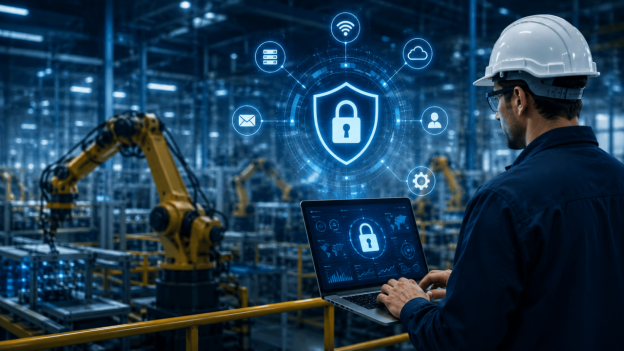
Cybersecurity Resources What Is Cybersecurity? 25 Top Cyber Attacks Why is a Security Operation Center (SOC) Needed? Manufacturing is getting more and more connected. Technology is now a key pillar to maintaining productivity in factories, from Industrial IoT (IIoT) and smart machinery to cloud applications, ERP systems, remote access, and digitally integrated supply chains. However, this connectivity also expands the attack surface for cybersecurity. Unlike many other industries, manufacturing cannot afford prolonged downtime. A cyberattack can disrupt production, logistics, supply chains, and customer deliveries. In India, the concern is significant: the India Ransomware Report 2024 identified manufacturing as the most targeted sector for ransomware attacks, ahead of finance and IT/ITeS. For manufacturers, cybersecurity must therefore go beyond protecting data and devices. The priority is building cyber resilience—the ability to detect threats, contain incidents, recover critical systems, and continue operations even when an attack succeeds. This is where cybersecurity companies can help manufacturers develop a more proactive security posture. Cybersecurity in Manufacturing Is Different Manufacturing environments combine traditional IT infrastructure with Operational Technology (OT), production equipment, PLCs, engineering workstations, and connected devices. As IT and OT converge, a compromise in one environment can potentially affect another, making security more complex than in conventional IT environments. The risk grows as factories adopt remote monitoring, cloud platforms, third-party applications, and connected supply chains. An employee account that has been compromised, an exposed endpoint, or a supplier connection can provide an entry point to the wider environment. This makes strong network security an essential part of cybersecurity, helping manufacturers reduce their exposure to cyber threats. Manufacturers must also protect product designs, engineering specifications, intellectual property, customer information, and business data. Data Loss Prevention (DLP), Endpoint security and appropriate access controls can help reduce the consequences of unauthorized access and data leakage. Moving Beyond Traditional Cybersecurity Preventing every cyberattack is impossible. The more important objective is ensuring that a cyber incident does not bring the business to a standstill. This requires a shift from prevention alone to cyber resilience, preparedness, and rapid recovery. A strong organization must identify suspicious activity quickly, isolate affected systems, and restore critical operations. 24X7 SOC Monitoring, SIEM, SOAR, EDR/XDR, threat detection and Incident Response can provide the visibility and response mechanisms required to act before an incident becomes a prolonged operational crisis. Organizations must also identify weaknesses before attackers exploit them. Regular Vulnerability Assessment and Penetration Testing (VAPT), Web Application Penetration Testing, patch management, and security testing can help identify vulnerabilities across infrastructure, applications, networks, and exposed assets. The Foundation of a Defensible Manufacturing Environment As IT and OT become increasingly interconnected, network security and network segmentation are critical safeguards. Separating production networks, administrative systems, critical applications, and externally accessible environments can limit an attacker’s ability to move laterally. An effective network security system can help prevent threats from spreading across critical production environments. Organizations should consider network security services that include continuous monitoring, access controls, threat detection, and network visibility. Manufacturing environments also involve employees, contractors, vendors and remote users. Identity and Access Management (IAM), strong authentication, privileged access controls and a Zero Trust approach can reduce risks associated with stolen credentials. Email security services can further help detect and block phishing, malicious attachments and credential theft. Lessons from India’s Manufacturing Sector The risks are already visible in India. In May 2023, a large motorcycle manufacturing company in India reportedly halted production following a cyberattack, with reports estimating that more than 20,000 vehicles were affected by the disruption. The company confirmed that it had reported the incident to the relevant government department. In June 2026, another manufacturing company disclosed a ransomware attack affecting its systems. The company said it had implemented precautionary measures and protocols to contain and mitigate the incident. These incidents reinforce a critical lesson: cyber risk is operational risk. A successful attack can affect production, supply chains, customer commitments, and business continuity – not simply computers and data. Network security and cybersecurity must therefore be integrated into operational resilience and business planning. Building a Manufacturing Cyber Resilience Strategy Manufacturers should use a layered approach that includes prevention, detection, response, and recovery. This includes Vulnerability Assessment and Penetration Testing, web application penetration testing, risk assessment, network security, IAM, DLP, endpoint security, secure backups, and 24×7 SOC monitoring. Technology alone cannot create resilience. Organizations also need employee awareness, documented incident response processes, supplier security assessments, and recovery exercises. Email security services can further strengthen protection against common attack vectors. For organizations without extensive in-house security resources, managed security services can provide specialized expertise and continuous monitoring. By combining proactive security assessments with threat detection, incident response, network security services, and recovery planning, manufacturers can build a stronger security posture. Conclusion As Indian manufacturing becomes more connected, the boundary between cybersecurity and operational continuity is disappearing. A compromised endpoint, stolen credential, or vulnerable third-party connection can potentially become a production problem. The objective is not perfect protection but the ability to detect threats early, respond decisively, and recover quickly. Cyber resilience enables manufacturers to protect their systems while maintaining the continuity their customers and supply chains depend on. For the modern factory, cybersecurity is no longer just about protecting technology. It is about protecting production, protecting trust and keeping the business going.
Why is a Security Operation Center (SOC) Needed?
Cybersecurity Resources What Is Cybersecurity? 25 Top Cyber Attacks Manufacturing Cybersecurity: Keeping Your Business Safe and Running What is a SOC? A modern SOC is not simply a room full of people looking at screens. With AI and automation, it can continuously analyze security data, identify unusual behavior, connect events that may appear unrelated, and help security teams prioritize threats that need immediate attention. For example, a suspicious login may not look dangerous on its own. But if the same account suddenly accesses sensitive data, downloads an unusual volume of files, and connects from an unfamiliar location, the combined activity can tell a very different story. This is where 24×7 SOC monitoring becomes valuable. It brings continuous visibility across Identity & Access Security Monitoring, Application Security Monitoring, Endpoint Detection & Response, Firewall Management, IDS/IPS Monitoring, Cloud Security Monitoring, Email Monitoring, and Data Loss Prevention. Businesses now have a better chance of spotting suspicious activity as it happens, instead of hearing about an incident after customers complain. SOC provides 24×7 Monitoring A cyberattack doesn’t have office hours. It can be 2 AM, a public holiday, or when your team is busy closing an important deal. Sometimes, the only warning you get is when sensitive data has already been stolen. In 2024, one of India’s largest cyberattacks targeted a popular cryptocurrency exchange, with hackers making away with digital assets valued at approximately ₹2,000 crore. The attack had hit about half of the estimated reserves on the platform and had affected millions of users. It was a sobering reminder of how cyber attacks can do much more than steal data and threaten thousands of crores in minutes. The issue is not whether a business can be attacked. The bigger question is how fast will someone know an attack is underway? This is where the AI-driven Security Operations Center comes in. Who Needs 24×7 SOC Monitoring? It is easy to think that SOC monitoring is only for banks, large enterprises, or government organizations. It is not. A sole entrepreneur may hold valuable customer information and intellectual property. An SME may depend on cloud applications, email, and online payments. A large organization may have thousands of employees, applications, and third-party connections to monitor. The size of the business does not determine the value of its data. In 2025, an Indian carsharing platform confirmed that hackers gained unauthorized access to its information systems, affecting data belonging to about 84 lakh users, including names, phone numbers, and vehicle registration details. Smaller businesses face risks too. In 2024, a leading IT company was hit by ransomware, forcing nearly 300 small Indian banks offline and disrupting UPI, ATM, and other payment services. The incident affected around 0.5% of India’s payment system volume. Whether you are a sole entrepreneur, an SME, or a large company, protecting customer information is not only about protecting data but also about protecting trust and business continuity. The Role of AI in SOC Monitoring The biggest advantage of an AI-driven SOC is not simply that it watches more systems. It can help security teams make sense of more information faster. Consider what happened in 2025 to a Bengaluru-based technology company. The company reported that cryptocurrency worth around ₹384 crore was stolen after attackers compromised a wallet. An internal investigation found that an employee’s laptop had been hacked. A SOC cannot guarantee that an attack will never happen. But continuous monitoring, endpoint detection, identity monitoring, and behavioral analysis can help organizations identify unusual activity earlier. This is where Vulnerability Assessment & Penetration Testing (VAPT), Proactive Threat Hunting, Security Information and Event Management (SIEM) and Security Orchestration, Automation & Response (SOAR) become important. They help identify weaknesses, search for hidden threats, and automate appropriate responses. The objective is simple: detect earlier, understand faster, and respond better. Key Considerations When Choosing a SOC Before choosing a SOC, businesses should look beyond the word “24×7.” Ask what is actually being monitored, how alerts are investigated, how quickly incidents are escalated, and whether the SOC can integrate with the technologies already being used. Security does not stop when an alert is raised. A serious incident may require an Incident Response Retainer, Digital Forensics & Investigation, or Threat Intelligence & IR Advisory to understand what happened, what was affected, and what should happen next. Businesses should also consider Security Policy & Governance Advisory and Security Awareness & Phishing Simulation. Technology can detect suspicious behavior, but employees remain an important part of the security chain. The right SOC should fit the business, its risks, technology, and people—not simply sell a list of tools. Compliance is good; continuous monitoring is better! Compliance matters. But compliance should not be the finish line. A business may meet a regulatory requirement and still have an employee clicking on a phishing email at midnight. It may have policies in place but not know that a cybercriminal is moving through its network. It may have security tools, but nobody is actively watching the alerts. Compliance tells you what you need to have in place. Continuous monitoring helps you understand what is actually happening. One is about meeting a requirement; the other is about being prepared when something goes wrong. The Future of Cybersecurity The threat landscape is changing quickly. Attackers are using automation, social engineering, and AI to make attacks faster and more convincing. Businesses are also adopting AI, cloud applications, and connected systems at an equally rapid pace. That means cybersecurity cannot remain a once-a-year assessment. It needs to become continuous. The future will belong to security operations that combine AI, human expertise, and automation. AI can process the enormous volume of signals generated by modern environments. Human analysts bring judgement, context, and decision-making when something genuinely serious happens. At Eagle, we believe technology should make organizations stronger, simpler, and more resilient—not more complicated. Stay Ahead with an AI-Driven SOC You do not need to be a large company to become a target. You