
Cybersecurity Resources
How AI-Driven SOCs Are Changing Security Operations
Imagine a company where hundreds of employees are working, customers are using its website, applications are running in the cloud, and hundreds of devices are connected to the network. Every second, these systems generate information about what is happening. Now imagine someone trying to check every single activity manually to find out if something is wrong. It would be almost impossible.
This is where AI in cybersecurity becomes important. Artificial Intelligence can quickly analyze large amounts of security data, identify unusual activity, and help security teams understand which alerts need attention. Instead of security professionals spending all their time checking routine alerts, AI can help them focus on activities that could actually be a cyber threat.
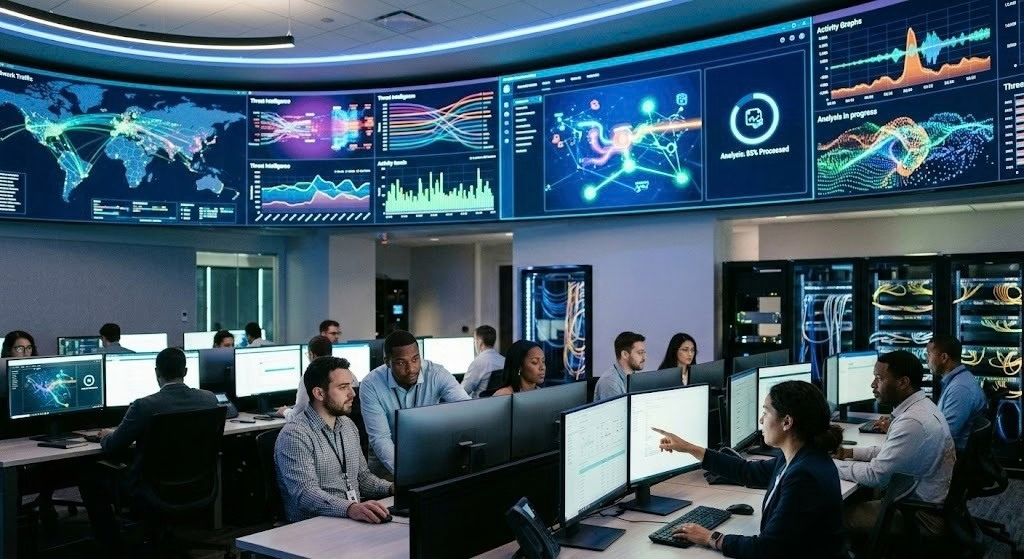
This change is especially visible in the AI-driven SOC (Security Operations Center). An AI-powered SOC combines Artificial Intelligence, machine learning, automation, threat intelligence and human expertise to monitor an organization’s digital environment. In simple terms, AI helps the SOC see more, understand more, and respond faster.
How AI Helps SOC Teams Manage Security Alerts Smarter
Imagine a security analyst starting the day and seeing hundreds or even thousands of security alerts. One alert says that someone has logged in from an unusual location. Another reports a suspicious file. Another shows multiple failed login attempts. Some alerts may be serious, while others may simply be normal business activity.
The problem is that these alerts do not always tell the complete story. A suspicious login by itself may not mean that an account has been compromised. But if the same user suddenly gets higher access, connects to an unusual system, and starts downloading large amounts of data, the situation becomes much more serious. A human analyst may have to manually connect all these events.
An AI-driven SOC can help with this problem. AI can analyze large numbers of security events and look for connections between them. This helps the SOC team identify which alerts need more attention and which ones may not be as important. The aim is not just to handle more alerts but to help analysts find the important ones faster.
From Alert Detection to Understanding the Attack
Finding a security alert is only the first step. The more important question is, what does this alert actually mean? For example, an employee logging in from a different location may be completely normal if they are travelling. But the same login could be suspicious if it happens at an unusual time and is followed by access to sensitive information.
This is where AI-powered threat detection can help. AI can look at different activities together instead of looking at every alert separately. It can compare information from users, devices, applications, networks, and other security tools to understand whether different events may be connected.
This helps the SOC move from simply asking, “Did something unusual happen?” to asking, “Could these activities be part of a cyberattack?” AI does not automatically mean that every unusual activity is an attack. Instead, it gives security analysts more information and context so they can investigate the situation properly.
AI-Driven SOC: Where Automation Meets Human Expertise
The purpose of an AI-driven SOC is not to remove people from cybersecurity. Human cybersecurity experts are still very important. They understand the organization, its business operations, and the possible impact of a security incident. They also make important decisions during complex incidents.
AI is useful because it can take care of many repetitive and time-consuming activities. For example, when a suspicious event is detected, AI and cybersecurity automation can help collect information about the user, device, application, and network involved. It can also bring related security events together for the analyst.
This means analysts can spend less time doing repetitive work and more time investigating serious incidents. In simple words, AI provides speed and scale, while cybersecurity professionals provide experience, judgement, and decision-making.
Why AI Matters in 24×7 SOC Monitoring
Cyberattacks do not happen only during office hours. A suspicious activity can happen at midnight, early morning, during weekends, or on a public holiday. This is why 24×7 SOC monitoring is important for organizations that need continuous security visibility.
A 24×7 SOC continuously monitors security events from different parts of an organization’s IT environment. AI can support this process by analyzing large amounts of information continuously and identifying activities that may need attention. This becomes even more important as businesses use cloud applications, remote working, SaaS platforms, and multiple connected devices.
The combination of AI-driven analysis and 24×7 SOC monitoring helps organizations maintain continuous security monitoring. Instead of depending only on people to manually check every event, AI can continuously process security information while analysts focus on events that require deeper investigation.
AI Can Help Detect What Rules May Miss
Traditional cybersecurity tools often use predefined rules to identify threats. For example, a security tool may be configured to generate an alert when a particular type of suspicious activity is detected. These rules are still useful and remain an important part of cybersecurity.
However, cyber attackers continuously change their methods. A new attack may not exactly match an existing rule. This is one reason why organizations need additional methods of threat detection.
AI can help by looking at behavior and identifying unusual patterns. For example, if an employee normally accesses five applications but suddenly starts accessing many sensitive systems at an unusual time, this activity may need investigation. The activity may be legitimate, but the change in behavior gives the SOC team a reason to look more closely.
AI and Faster Incident Response
When a cyberattack happens, time is important. The longer an attacker remains inside an organization’s systems, the more opportunity they may have to access information, move to other systems, or cause damage. This is why incident response is an important part of cybersecurity.
AI-powered security operations can help security teams respond faster by automating some repetitive activities. Depending on the organization’s security setup, automation can help collect evidence, gather information about an alert, connect related events, and start predefined response processes.
However, automation does not mean that every security decision should be made by AI. AI-driven incident response should work with proper security policies and human oversight. Routine actions can be automated, while important decisions can remain with experienced cybersecurity professionals.
The Role of AI in Threat Intelligence
Every day, cybersecurity teams receive a large amount of threat intelligence. This can include information about malicious IP addresses, suspicious domains, malware, vulnerabilities, and different cyberattack techniques. The challenge is understanding which information is relevant to a particular organization.
AI can help analyze and connect this information with security events inside the organization. For example, suppose a security alert shows that an employee’s computer has connected to a suspicious website. AI can help bring together information about that website, the device, the user’s activity, and other related security events.
This makes threat intelligence more useful for an AI-powered SOC. Instead of simply storing information about known threats, the SOC can use that information as additional context during an investigation. This can help analysts better understand what they are seeing and decide whether an event needs further investigation.
AI Does Not Eliminate False Positives—It Helps Manage Them
One of the common challenges for SOC teams is a false positive. This happens when a security tool generates an alert that looks suspicious but is actually caused by legitimate activity. For example, an employee may log in from another country because they are travelling, but the security system may flag it as unusual.
If analysts have to investigate too many false positives, they can spend a large amount of time checking events that are not actual threats. At the same time, important alerts may be waiting in the queue. This is why alert prioritization is an important part of modern SOC operations.
AI can help by looking at additional information and analyzing patterns across different events. This can help security teams understand which alerts may need more attention. The goal is not simply to reduce the number of alerts. The goal is to make alerts more useful so that analysts can spend their time investigating events that matter.
Building a Smarter SOC for the Future
The future of cybersecurity is not about choosing between people and AI. It is about making AI, automation, and cybersecurity professionals work together. AI can process large amounts of information quickly, while experienced analysts can understand the business situation and make important decisions.
For organizations, an AI-driven SOC can become much more than a place where security alerts are monitored. It can help detect suspicious behavior, connect security events, support investigations, and coordinate responses across different parts of the IT environment.
This is why AI in cybersecurity is becoming increasingly relevant. As organizations use more cloud services, applications, connected devices, and digital platforms, the amount of security data will continue to grow. AI can help security teams manage this growing volume of information while allowing human experts to focus on the incidents that require deeper investigation.
The Future of Cybersecurity Is Not Just AI—It Is AI + Intelligence + Humans
Cybersecurity has always involved a race between attackers trying to find weaknesses and defenders trying to protect systems. AI is changing the speed of this race. It can help security teams process more information, identify patterns, automate repetitive tasks, and support faster threat detection and incident response.
But AI alone cannot secure an organization. A strong cybersecurity strategy still needs experienced security analysts, reliable security data, threat intelligence, cybersecurity automation, 24×7 SOC monitoring, incident response, vulnerability management, and strong security processes.
The AI-driven SOC of the future will therefore not simply be a collection of dashboards or an AI system making every decision. It will be a security operation where AI continuously analyses information, automation handles suitable repetitive tasks, and cybersecurity experts investigate and respond to important incidents. The real value of AI is not just finding more alerts—it is helping security teams understand which signals matter and what they should investigate next.
Conclusion
The relevance of AI in cybersecurity is simple: organizations are generating more security data than humans can efficiently analyze manually. AI can help security teams process this information, identify patterns, prioritize alerts, and support faster threat detection and incident response.
An AI-driven SOC brings these capabilities together with 24×7 SOC monitoring, cybersecurity automation, threat intelligence, and human expertise. Instead of simply receiving thousands of alerts, security teams can use AI to understand relationships between events and focus their attention on activities that may represent genuine threats.
The future of cybersecurity will not be about AI working alone. It will be about AI + intelligence + humans working together. When AI handles large-scale analysis and repetitive tasks while experienced cybersecurity professionals provide context and judgement, organizations can build a SOC that is faster, smarter, and better prepared to respond to the changing cyber threat landscape.
Frequently Asked Questions About AI in Cybersecurity
What is AI in cybersecurity?
AI in cybersecurity means using Artificial Intelligence and machine learning to analyze security information, identify unusual activity, detect potential threats, support investigations, and automate selected security tasks. It helps security teams process large amounts of security data more efficiently.
What is an AI-driven SOC?
An AI-driven SOC is a Security Operations Center that uses Artificial Intelligence, machine learning, automation, analytics, threat intelligence, and human expertise to monitor, detect, investigate, and respond to cybersecurity threats.
How does AI improve SOC operations?
AI can help a SOC analyze large amounts of security data, connect related events, identify unusual behavior, prioritize alerts, and support incident investigations. Cybersecurity automation can also reduce repetitive manual work and allow analysts to focus on more complex security incidents.
Can AI replace SOC analysts?
No. AI can support SOC analysts, but human expertise remains important. Analysts are needed to understand business context, investigate complex incidents, validate findings, and make important security decisions. AI works best as a tool that augments and supports cybersecurity professionals.
How does AI help with threat detection?
AI can analyze behavior and patterns across users, devices, applications, networks, and other security data. It can identify activity that is different from normal behavior and provide additional information to analysts. This can complement traditional rule-based and signature-based threat detection.
Why is AI important for 24×7 SOC monitoring?
A 24×7 SOC continuously monitors an organization’s digital environment. AI can help process and prioritize the large amount of security information generated throughout the day and night. This allows security analysts to focus on potentially important events while continuous monitoring continues.
What is the difference between a traditional SOC and an AI-driven SOC?
A traditional SOC may depend heavily on predefined rules, manual investigation, and analysts reviewing large numbers of alerts. An AI-driven SOC adds capabilities such as AI-based analysis, behavioral analysis, automated alert enrichment, event correlation, and cybersecurity automation to support security teams.
Is AI enough to protect an organization from cyberattacks?
No. AI is one part of a broader cybersecurity strategy. Organizations also need 24×7 SOC monitoring, identity security, endpoint security, network security, vulnerability management, threat intelligence, incident response, governance, and skilled cybersecurity professionals.