
Cybersecurity Resources
For example, an employee receives an email that looks like it is from a trusted business partner and opens an invoice attachment. The attachment contains malware, giving an attacker access to the company’s systems. Within hours, files may be encrypted, operations may stop, and sensitive information may be stolen. This can quickly become a serious incident involving ransomware in cyber security, data theft, and business disruption.
Cybersecurity is about preventing attacks, detecting threats, responding quickly, and protecting the business from financial loss, operational disruption, data exposure, and reputational damage. As businesses use more cloud and connected technologies, cloud cyber security, enterprise network security, industrial network security, and SIEM cyber security have become important. Businesses can also use cybersecurity as a service, cloud security services, and cyber security managed services to strengthen protection against the latest cyber threats.
What Cybersecurity Means
At its simplest, cybersecurity means protecting computers, networks, applications, devices, systems, and data from unauthorised access, cyberattacks, theft, damage, and disruption. It is much more than installing antivirus software or a firewall. Like a building uses locks, cameras, alarms, and security guards, cybersecurity uses different layers such as firewalls, endpoint security, identity controls, encryption, backups, vulnerability management, incident response, and security monitoring.
For example, if an employee suddenly logs in from another country at 3 a.m. and tries to download thousands of customer records, this unusual activity could indicate a compromised account. With security monitoring and SIEM cyber security, the activity can be detected and investigated quickly. The security team can block the account and stop sensitive information from being stolen.
As businesses move applications and data to the cloud, cloud cyber security has become equally important. Cloud security solutions, cloud security services, and a cloud security platform can help protect cloud applications, infrastructure, identities, and data. The goal is simple: to make sure businesses can trust their digital environment and remain protected from the latest cyber threats.
Why Every Business Needs Cybersecurity
Cyberattacks can happen to businesses of every size—not only large corporations. Small businesses, mid-sized companies, enterprises, healthcare organisations, manufacturers, and professional service firms can all become targets. Attackers may target valuable customer information, financial data, business systems, or companies with weaker security. One compromised employee account can sometimes provide an attacker with an entry point into the business.
The risk increases when businesses depend on cloud applications for email, accounting, customer management, file sharing, and collaboration. Stolen credentials can give attackers access to multiple systems without physically entering the office. This is why businesses are investing in cloud security solutions, cloud security services, cloud security companies, and cloud security providers, along with security monitoring and other cybersecurity solutions.
A cyberattack can result in financial losses, downtime, data theft, customer information exposure, regulatory penalties, lost customer trust, reputational damage, and recovery costs. Businesses can work with cyber security solution providers, cyber security vendors, managed security providers, and a managed security service provider (MSSP) to improve their protection. The important question is not, “Will someone attack us?” but “If an attack happens, are we prepared to detect and stop it?”
Cybersecurity vs. IT Security
The terms cybersecurity and IT security are often used in the same way, but they are not exactly the same. IT security mainly focuses on protecting computers, servers, networks, applications, and data. Cybersecurity has a broader focus on protecting the complete digital environment from cyberattacks, malicious activity, and changing cyber risks.
For example, businesses may use network firewalls, antivirus software, access controls, security patches, and data backups as part of IT security. Cybersecurity goes further by asking whether someone is trying to steal employee credentials, whether unusual network traffic indicates an attack, whether malware has entered the system, or whether ransomware is reaching critical systems. It also focuses on how quickly the organisation can detect and respond.
This difference is especially important for businesses requiring enterprise network security, industrial network security, cloud protection, and continuous security monitoring. Modern cybersecurity must protect traditional IT systems as well as cloud infrastructure, remote users, connected devices, applications, and operational technology. Businesses need a complete security approach to stay prepared for the latest cyber threats.
What Businesses Are Trying to Protect
When people hear cybersecurity, they often think about computers and networks. But businesses are actually protecting much more—information, operations, people, and trust. This includes customer data, payment information, financial records, employee information, business contracts, and other sensitive data. Businesses also need to protect intellectual property such as software, designs, research, processes, and business strategies.
Cybersecurity also helps protect business operations and continuity. Imagine a manufacturing facility where production systems stop working, a logistics company cannot access its scheduling platform, or a professional services company cannot access important client files. Employee accounts are another important area because one compromised account can become the starting point for a larger attack. Strong identity controls, authentication, monitoring, and employee awareness can help reduce these risks.
As businesses increasingly use cloud applications and infrastructure, protecting cloud workloads, identities, configurations, and data has become essential. This has increased the need for cloud security providers, cloud security companies, and cloud security platforms. When comparing top cloud security companies, businesses should look at monitoring, integration, scalability, response capabilities, and the provider’s ability to support their specific environment.
Common Cybersecurity Risks
Cyber threats continue to change and become more advanced. The latest cyber threats can involve social engineering, malware, stolen credentials, system vulnerabilities, and automated attacks. Businesses should understand these risks and take the right steps to protect their systems, data, employees, and operations.
Phishing uses fake emails, messages, or websites to trick people into sharing sensitive information. Credential theft involves stealing usernames and passwords that can provide access to email, cloud applications, financial systems, customer information, or internal networks. Multi-factor authentication, identity monitoring, access controls, and employee awareness can help reduce these risks.
Ransomware in cyber security can encrypt business files and systems and demand payment for restoring access. Other risks include malware, insider threats, and software or cloud vulnerabilities. Businesses need security monitoring, backup strategies, vulnerability management, incident response, and recovery planning to reduce the impact of these threats.
Why Cybersecurity Is a Business Issue, Not Just an IT Issue
Cybersecurity is not only the responsibility of the IT department. A cyberattack can affect revenue, operations, customers, employees, compliance, reputation, and business continuity. For example, if ransomware stops critical applications, employees cannot work, customer orders cannot be processed, finance teams cannot access accounting systems, and management cannot access important business information. Every hour of downtime can cost the business money.
This is why organisations are increasingly using cybersecurity as a service, managed security providers, and a managed security service provider (MSSP). These services can provide continuous monitoring, threat detection, incident support, vulnerability management, and security expertise. Cyber security managed services can be especially useful for businesses that do not have the resources or specialised skills to manage security internally.
For organisations that need security monitoring around the clock, a 24×7 Security Operations Center (SOC) can play an important role. A SOC continuously monitors systems, networks, cloud environments, and security alerts to identify suspicious activity and respond quickly—even outside normal working hours. Cyberattacks can happen at any time, so having 24×7 security operations center support can help businesses detect threats earlier, reduce response time, and limit potential damage.
Cybersecurity Is About Being Ready Before the Attack
Cybersecurity cannot guarantee that a business will never be attacked. The goal is to make the business harder to compromise, faster at detecting threats, and better prepared to respond and recover. A strong security strategy follows four important steps: Prevent → Detect → Respond → Recover.
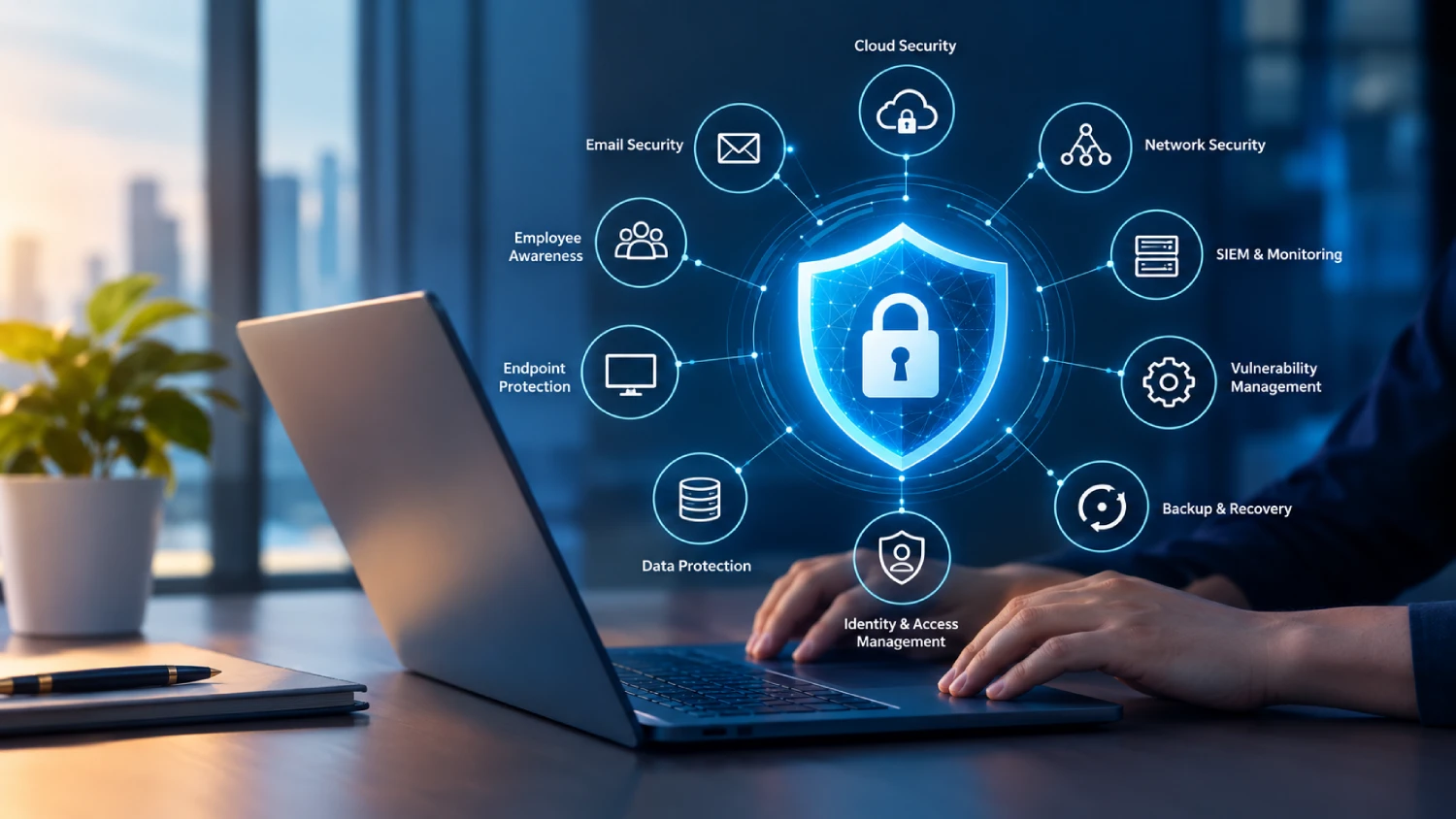
Businesses can combine endpoint protection, network security, identity controls, cloud security, employee awareness, vulnerability management, security monitoring, backups, and incident response to build stronger protection. For cloud environments, cloud security solutions and cloud security services can extend protection beyond traditional infrastructure, while SIEM cyber security can bring security events together for better monitoring and investigation.
The important thing is not simply having more security tools. It is about having the right cybersecurity strategy for the business. Continuous monitoring through a 24×7 Security Operations Center, supported by managed security providers and the right security technologies, can help organisations identify threats early and respond before a small security incident becomes a major business problem.
Is Your Business Protected From Today’s Cyber Threats?
Cybersecurity is no longer an optional IT investment. It is an important part of protecting the business, its people, customers, data, operations, and reputation. Whether the concern is ransomware, phishing, stolen credentials, cloud risks, insider threats, or other emerging attacks, understanding your security gaps is the first step towards better protection.
The right combination of cloud security solutions, enterprise network security, industrial network security, SIEM cyber security, security monitoring, cybersecurity as a service, and cyber security managed services can help businesses build a stronger and more practical security strategy.
Is your business protected from today’s cyber threats? Talk to Eagle. Eagle can help businesses strengthen their cybersecurity with the right combination of security solutions, expertise, monitoring, and managed services—helping you stay focused on your business while staying prepared for evolving cyber threats.