
Cybersecurity Resources
It is 8:15 on a Monday morning. You get into your car, start the engine, connect your phone, enter your destination and drive to work. Nothing feels unusual. The car adjusts the seat, checks the battery, communicates with cloud services, processes sensor data and continuously exchanges information with systems outside the vehicle. To you, it is simply a commute.
But behind that ordinary journey is an extraordinary amount of technology. Modern connected vehicles can contain dozens of electronic control units, cameras, sensors, wireless interfaces, applications and communication systems. Cars are no longer isolated machines; they are increasingly connected digital ecosystems. And wherever there is connectivity, there is another question that manufacturers, suppliers and fleet operators must answer: how secure is it?
That question has turned automotive cybersecurity into a business-critical issue. A cyberattack on a connected vehicle could potentially affect far more than personal data. Depending on the system compromised, attackers may target vehicle functions, connected services, manufacturing environments, customer applications, corporate networks or sensitive intellectual property. The automotive industry is therefore entering a new era where cybersecurity has to be considered alongside safety, reliability and performance.
The Day a Car Stopped Being Just a Car
For decades, a car was largely a mechanical system. You turned a key, the engine responded and the vehicle performed a relatively predictable sequence of physical actions. Today, that simplicity has changed dramatically. Vehicles increasingly depend on software for everything from entertainment and navigation to driver assistance, battery management and communication with external services.
A modern vehicle can communicate with smartphones, mobile applications, dealerships, cloud platforms, charging infrastructure, roadside systems and other connected services. Software updates can be delivered remotely, while telematics systems can transmit information about the vehicle and its operation. The same connectivity that makes driving more convenient can also create additional digital entry points that need to be secured.
This is what makes automotive cybersecurity different from traditional IT security. The potential attack surface does not stop at a laptop or server. It can extend across the vehicle, mobile applications, cloud infrastructure, manufacturing systems, suppliers and connected services. In other words, securing the modern automobile means thinking about an entire ecosystem rather than a single device.
The Invisible Attack Surface Inside a Modern Vehicle
Consider everything happening before a vehicle even reaches the road. Automotive manufacturers depend on design systems, engineering applications, software development environments, factories, suppliers and logistics networks. A weakness anywhere along that chain can potentially become a cybersecurity concern. The growing software content of vehicles means that cybersecurity must increasingly be considered throughout development and production.
Once the vehicle reaches the customer, the ecosystem becomes even larger. Infotainment systems, Bluetooth, Wi-Fi, cellular connectivity, mobile applications, APIs, cloud platforms and remote services can all introduce security considerations. Fleet operators may add another layer through centralized management platforms, while electric vehicles can introduce additional dependencies around charging and energy infrastructure.
The result is an attack surface that is constantly changing. A vulnerability may not necessarily come from the vehicle itself; it could involve an application, supplier, cloud environment, credential, API or connected service. That is why automotive cybersecurity requires continuous visibility rather than a security assessment performed only once.
What Happens When Cybercriminals Take the Driver’s Seat?
A driver receives a notification from a vehicle application. It looks legitimate. The driver follows a link and enters credentials. Somewhere else, an attacker has been waiting for exactly that opportunity. The compromised credentials could potentially provide access to connected services, personal information or another part of the digital ecosystem.
This is only one possible scenario. Cybercriminals may target vehicle manufacturers, dealerships, suppliers, fleet operators, connected applications or corporate environments rather than the vehicle itself. Ransomware, phishing, credential theft, software vulnerabilities, supply-chain attacks and API abuse can all become relevant threats when automotive systems are connected to wider digital infrastructure.
The important point is that automotive cyber risk is not only about someone attempting to interfere with a car. It is about protecting the entire digital journey surrounding the vehicle. A compromised supplier account, vulnerable application or breached corporate network can create consequences far beyond the original entry point.
Then AI Walked Into the Fight
Just as manufacturers are using AI to transform products and operations, cybercriminals can use AI to transform attacks.
AI can help attackers automate tasks, generate convincing messages, analyze information and increase the scale and speed of certain malicious activities. Generative AI can also make phishing and social-engineering attempts more convincing by helping attackers produce personalized content. The challenge is not that AI has created every cyber threat; rather, it can give existing attack techniques greater speed, scale and adaptability.
That creates an uncomfortable situation for the automotive industry. Organizations are increasingly using AI, automation, cloud platforms and connected technologies to build smarter vehicles and more efficient operations, while attackers can use similar technological advances to search for weaknesses. The cybersecurity race is therefore no longer simply about who has more security tools. It is increasingly about who can identify meaningful signals faster and respond intelligently.
AI also creates another cybersecurity challenge: protecting AI itself. Automotive companies adopting AI need to consider data protection, access controls, model security, application security and monitoring. As AI becomes integrated into business processes and connected environments, cybersecurity needs to evolve alongside it rather than being added afterward.
Why Traditional Security Alone Is Not Enough
One alert indicates an unusual login. Another flags suspicious endpoint activity. A third reports an abnormal network connection. Individually, each event might appear relatively harmless. But when the events are connected, they may reveal something much more significant: an attacker moving through the environment.
This is one of the challenges created by modern automotive ecosystems. Security teams have to process information from endpoints, networks, cloud environments, identities, applications and other systems. Simply collecting alerts does not automatically create security. Organizations need visibility, correlation, investigation and a way to prioritize what actually requires attention.
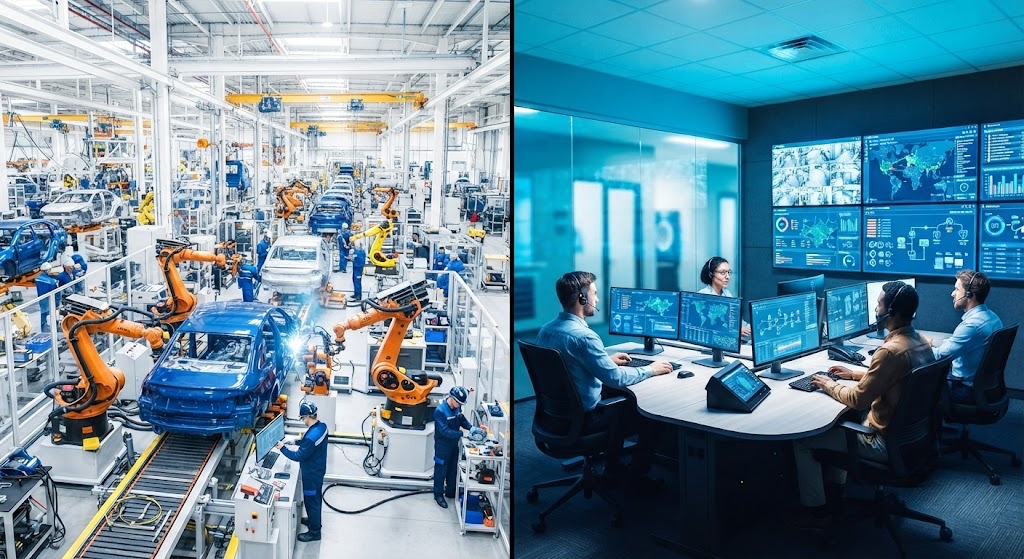
That is where a modern AI-driven Security Operations Center (SOC) becomes increasingly relevant. AI and automation can help analyze large volumes of security data, identify patterns and prioritize suspicious activity, while human analysts provide context, investigation and decision-making. The objective is not to replace cybersecurity professionals; it is to help them focus their expertise where it matters most.
AI-Driven SOC: From Thousands of Alerts to One Clear Story
Return to our earlier example. Imagine that the security team receives an unusual login alert. On its own, it may not be enough to trigger an investigation. But an AI-enabled SOC can help correlate that activity with endpoint behavior, identity events, network traffic and other signals.
Suddenly, the story becomes clearer. An unusual login is followed by access to a sensitive application. A device begins communicating with an unfamiliar destination. Large amounts of information are accessed. What looked like several unrelated events can become one connected security incident that deserves immediate attention.
Eagle’s cybersecurity approach combines AI-assisted monitoring with expert analysis, using technologies such as SIEM and SOAR to support continuous visibility, alert correlation and response. Its SOC provides 24×7 monitoring across areas including identity, endpoints, networks, cloud, applications, email and data loss prevention.
What Should Automotive Companies Be Watching?
The first priority is visibility. Organizations need to understand what is connected to their environment, which systems are communicating, where sensitive data is moving and where vulnerabilities exist. Without visibility, security teams can struggle to distinguish normal activity from suspicious behavior.
The second priority is resilience. Vulnerability assessments, penetration testing, endpoint protection, identity security, network monitoring, threat intelligence, incident response and data protection all play different roles in reducing cyber risk. For automotive organizations, these controls may need to extend beyond corporate IT into connected ecosystems, suppliers and critical operational environments.
The third priority is continuous improvement. Threats evolve, software changes, new vulnerabilities emerge and business environments expand. Automotive cybersecurity therefore needs to operate as an ongoing process rather than a one-time project. Continuous monitoring and proactive threat hunting can help organizations identify suspicious activity before it becomes a larger operational problem.
The Future of Automotive Cybersecurity Is Already Here
The automotive industry is moving toward vehicles that are more connected, software-defined and dependent on digital ecosystems. That transformation brings enormous opportunities, but it also changes what cybersecurity means. The question is no longer simply whether a vehicle is physically secure; organizations must also consider whether the software, data, connectivity, suppliers and infrastructure surrounding it are secure.
AI will be an important part of this future. It can help defenders process enormous quantities of security data, identify patterns and automate parts of the response process. At the same time, organizations must recognize that attackers can also use AI to accelerate and adapt their operations. The advantage will come from combining technology with strong processes, skilled people and continuous monitoring.
For automotive businesses, the goal should therefore be clear: build cybersecurity into the vehicle ecosystem from development and manufacturing through deployment, updates and retirement. Security needs to move at the same speed as automotive innovation—because a connected vehicle cannot be truly connected if its security is left behind.
How Eagle Can Help Secure the Automotive Journey
Eagle provides cybersecurity services designed around continuous monitoring, detection, response and proactive risk management. Its cybersecurity portfolio includes 24×7 SOC monitoring, endpoint detection and response, firewall and IDS/IPS monitoring, application and API security monitoring, identity and access monitoring, cloud security monitoring, vulnerability assessment and penetration testing, threat intelligence, proactive threat hunting, incident response and digital forensics.
At the heart of this approach is Eagle’s AI-enabled SOC, where AI-assisted monitoring and expert security analysis work together. Eagle describes its approach as combining AI, automation and human expertise to support faster detection and more informed response, while its six-tiered defense framework brings monitoring and detection, incident handling, data loss prevention, proactive risk management, threat intelligence, and governance together.
For automotive manufacturers, suppliers, mobility companies and connected-vehicle ecosystems, cybersecurity is no longer something that can sit quietly in the background. It needs to move with the vehicle, the software, the data and the business. Because the future of mobility will be connected—and the organizations that build, operate and support that future need security that keeps moving too.
Frequently Asked Questions
1. What is automotive cybersecurity?
Automotive cybersecurity refers to the technologies, processes and practices used to protect vehicles, automotive software, connected systems, manufacturing environments, cloud platforms and vehicle-related data from cyber threats. As modern vehicles become increasingly connected, cybersecurity helps protect the entire digital ecosystem surrounding the vehicle.
2. Why is cybersecurity important in the automotive
industry?
Cybersecurity is important because modern vehicles and automotive businesses rely on connected technologies, software, cloud services, mobile applications, APIs and third-party suppliers. A cyberattack could potentially compromise sensitive data, disrupt business operations, exploit connected systems or affect vehicle-related services. A strong automotive cybersecurity strategy helps organizations identify vulnerabilities, monitor threats and respond to incidents.
3. How is AI changing automotive cybersecurity and
cybercrime?
AI is changing both sides of the cybersecurity landscape. Cybercriminals can use AI to automate activities, create more convincing phishing campaigns, analyze information and increase the speed and scale of attacks. At the same time, cybersecurity teams can use AI to analyze large volumes of security data, identify suspicious patterns, prioritize alerts and support faster incident response.
4. What is an AI-driven SOC and how can it help automotive
companies?
An AI-driven Security Operations Center (SOC) uses AI, automation, security analytics and human expertise to continuously monitor an organization’s digital environment. For automotive companies, an AI-driven SOC can help correlate security events across endpoints, networks, cloud environments, identities and applications, helping security teams identify suspicious activity and respond to potential threats more efficiently.
5. How can Eagle help with automotive cybersecurity?
Eagle can help automotive organizations strengthen their cybersecurity through 24×7 SOC monitoring, threat detection and response, endpoint security, identity and access monitoring, cloud security monitoring, vulnerability assessment and penetration testing, threat intelligence, proactive threat hunting, incident response and digital forensics. Its AI-enabled SOC combines AI-assisted security monitoring, automation and cybersecurity expertise to help organizations continuously detect and respond to evolving threats.