
Cybersecurity Resources
Protecting the Factory Floor in the Age of AI
At 2:17 a.m., the factory was supposed to be quiet. Machines were running, robotic arms were moving, sensors were feeding data into dashboards, and production was continuing exactly as planned. Then one screen went blank. A conveyor stopped. Another machine followed. Within minutes, the production manager realised this was not a mechanical failure. Something had entered the network.
This is the new reality of cybersecurity in manufacturing. Modern factories are no longer isolated environments filled only with machines. They are connected ecosystems where enterprise IT, operational technology (OT), Industrial IoT (IIoT), cloud platforms, remote access, suppliers and automated production systems work together. That connectivity creates enormous opportunities for efficiency—but it also creates more paths for cybercriminals to enter. CISA identifies increased connectivity, vulnerable industrial control systems, IoT, ransomware and IT-OT integration among the cybersecurity risks facing critical manufacturing.
And the stakes are different on a factory floor. A cyberattack may not simply steal information or lock a few computers. It can interrupt production, affect supply chains, expose intellectual property, interfere with industrial processes and create safety concerns. When a connected manufacturing environment is compromised, the consequences can move quickly from the digital world into the physical world.
When the Factory Became Connected, the Attack Surface Changed
For decades, many manufacturing systems operated with limited external connectivity. Then Industry 4.0 arrived. Sensors started communicating with machines. Production systems connected with business applications. Engineers began managing equipment remotely. Cloud platforms started collecting operational data. What once looked like separate islands gradually became one connected digital ecosystem.
That transformation brought measurable benefits: predictive maintenance, real-time production visibility, automated quality checks and data-driven decision-making. But every connection can also become a potential route into the environment. Legacy equipment, remote-access technologies, connected devices and third-party systems can introduce security weaknesses that attackers may attempt to exploit.
Imagine an attacker finding a weakness in an employee account, a remote-access system or a third-party connection. The initial compromise may happen far away from the production line. But if the attacker moves laterally into OT systems, the consequences can eventually reach the factory floor. This is why manufacturing cybersecurity can no longer be treated as simply protecting laptops, servers and emails; it must also account for the systems controlling physical operations.
Cybercrime Has Found a New Target: Downtime
A manufacturer does not need to lose terabytes of data to suffer a major cyber incident. Sometimes, stopping production for a few hours can be enough. When automated lines stop, deliveries can be delayed, workers can be affected, orders can pile up and customers can begin looking elsewhere. The financial impact can continue long after the original malware has been removed.
Ransomware is particularly concerning because attackers understand the value of operational continuity. Locking business files is one thing; disrupting systems connected to production can create enormous pressure to restore operations quickly. CISA identifies ransomware among the significant cybersecurity risks affecting critical manufacturing, highlighting how attacks can threaten both information systems and operational environments.
But ransomware is only part of the story. Manufacturers also face phishing, credential theft, malware, insider threats, supply-chain compromise, exploitation of vulnerable systems, attacks against exposed services and attempts to steal intellectual property. The challenge is that attackers do not need to attack the most sophisticated system first. They only need to discover the weakest connected door.
AI Is Changing the Cybercrime Game
AI is becoming a powerful tool for defenders—but cybercriminals can use the same technology to make attacks faster, more scalable and more convincing. AI can assist attackers with reconnaissance, social engineering, content generation and automation, potentially reducing the time required to develop and execute certain attacks.
The threat is particularly relevant in manufacturing because industrial environments generate huge volumes of operational and security data. At the same time, modern manufacturing increasingly depends on AI, IIoT, robotics, digital twins and connected systems. CISA notes that smart manufacturing changes the attack surface through AI and machine learning, networked devices, network communication between IT and OT environments and third-party supply-chain connections.
The result is an unusual cybersecurity race. Attackers are looking for ways to automate discovery and exploitation, while defenders are looking for ways to automate detection and response. AI does not replace cybersecurity fundamentals, but it can help security teams analyse large volumes of signals, identify unusual behaviour and prioritise potential threats. In manufacturing, that ability can be especially valuable when thousands of devices and events are generating security data simultaneously.
The Rise of the AI-Driven SOC
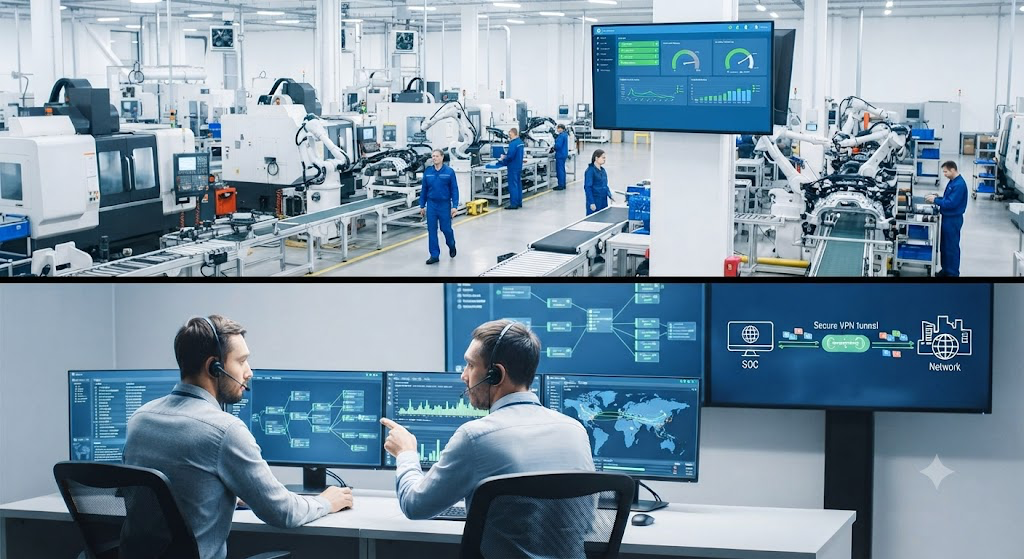
Instead of waiting for someone to notice that a machine is behaving strangely, an AI-driven Security Operations Center (SOC) continuously watches security signals across the environment. It can correlate events from endpoints, networks, identities, applications and other security systems, helping analysts see connections that may otherwise be difficult to spot.
This matters because a single alert rarely tells the entire story. A suspicious login might appear harmless. Add an unusual remote connection, abnormal file activity and unexpected communication with another system, and the picture changes. AI-assisted analytics can help connect these events, while automation can support repetitive response workflows. Eagle’s SOC combines AI-assisted monitoring, expert analysis, SIEM visibility and SOAR-enabled automation to support continuous threat detection and response.
For manufacturing organisations, the objective is not simply to collect more alerts. It is to create better visibility across the digital environment and shorten the journey from detection to investigation to response. A modern SOC can support continuous monitoring, threat hunting, endpoint detection, identity monitoring, network monitoring and incident response—helping security teams respond to suspicious activity before it becomes a larger operational problem.
Building Cyber Resilience Across the Factory
The first step is visibility. Manufacturers need to understand what is connected to their environment, which systems are critical, how IT and OT communicate, where remote access exists and where vulnerabilities could create operational risk. Without an accurate picture of the environment, it becomes difficult to determine which security events require immediate attention.
Next comes layered protection. Network segmentation, strong identity controls, endpoint security, vulnerability management, secure remote access, threat intelligence, continuous monitoring and tested incident-response processes can work together to reduce exposure. OT security also needs to consider operational requirements, because security controls must protect systems without unnecessarily disrupting processes that need to run continuously.
Finally, cybersecurity needs to become continuous rather than occasional. A vulnerability assessment performed once a year cannot provide visibility into what happens every night, every weekend or during a production shutdown. Manufacturers need a security strategy that combines technology, people, processes and monitoring—because cyber threats do not operate according to production schedules.
How Eagle Can Help Manufacturers Stay Secure
Eagle brings together cybersecurity capabilities designed to provide continuous visibility, detection and response. Its 24×7 SOC uses technologies including SIEM, SOAR, EDR and XDR, supported by L1, L2 and L3 capabilities. Eagle also offers threat intelligence, proactive threat hunting, vulnerability assessment and penetration testing, identity and zero-trust monitoring, cloud security monitoring, network monitoring, incident response and digital forensics.
For manufacturing organisations, this approach can help connect different parts of the security picture rather than treating every alert as an isolated event. Eagle’s AI-enabled SOC combines continuous monitoring and intelligent analysis with expert-led decision-making, while its broader cybersecurity framework brings monitoring, incident handling, data protection, risk management, threat intelligence and governance into a connected model.
The factory of the future will be more connected, more automated and increasingly intelligent. That means its cybersecurity strategy must evolve at the same pace. Cybersecurity in manufacturing is no longer only about protecting computers—it is about protecting production, people, data, intellectual property and business continuity. With AI changing both the attack and defence landscape, manufacturers need visibility that never sleeps, intelligence that can keep up and experts who know when to act. Eagle’s 24×7 SOC and AI-enabled cybersecurity approach can help manufacturers build that layer of continuous protection—so when the next alert appears at 2:17 a.m., someone is already watching.
Frequently Asked Questions
1. What is cybersecurity in manufacturing?
Cybersecurity in manufacturing is the practice of protecting factories, production systems, operational technology (OT), Industrial IoT (IIoT), networks, devices, data and connected systems from cyber threats. It helps manufacturers prevent disruptions, data theft, ransomware attacks and unauthorised access while maintaining secure and continuous operations.
2. Why is cybersecurity important for manufacturing
companies?
Cybersecurity is important because modern manufacturing environments are increasingly connected through IT, OT, cloud platforms, IoT devices and remote-access technologies. A cyberattack can disrupt production, compromise sensitive information, affect supply chains and potentially create operational and safety risks.
3. What are the most common cyber threats to
manufacturing?
Common cybersecurity threats to manufacturing include ransomware, phishing, credential theft, malware, insider threats, supply-chain attacks, vulnerabilities in legacy systems, unauthorised remote access and attacks against exposed industrial systems. Attackers may target IT systems first and then attempt to move toward critical OT environments.
4. How is AI changing cybersecurity in manufacturing?
AI is changing both cyberattacks and cybersecurity defence. Cybercriminals can use AI to automate activities and create more convincing social-engineering attacks, while security teams can use AI to analyse large volumes of security data, identify unusual behaviour, correlate alerts and accelerate threat detection and response.
5. How can an AI-driven SOC help protect manufacturing
companies?
An AI-driven SOC (Security Operations Center) provides continuous monitoring of security activity across networks, endpoints, identities and other systems. AI-assisted analysis can help identify suspicious patterns and prioritise threats, while security experts investigate incidents and initiate appropriate response actions. For manufacturers, this can improve visibility and help reduce the time between threat detection and response.